

More Than Meets the Eye: Why Our Brains Are Wired for the Movies
- Edoardo Ceron
- Dec 21, 2025
- 4 min read

Updated: Aug 31

If you were to place a newborn kitten next to its mother in a dark room, it would find its way almost immediately. It would rely on smell, touch, and vibration. For the kitten, the world is first understood through physical signals rather than sight.
A human baby reacts very differently. Even with blurry, undeveloped vision, an infant instinctively tries to look outward. Their eyes search for shapes, contrast, and—most importantly—faces.
Humans are deeply visual creatures. While we use all our senses, sight plays a central role in how we understand the world and each other. From an early age, we rely on visual information to identify our own mother, read emotion, and make sense of our surroundings. This is why phrases like “seeing is believing” exist across cultures and languages.
This preference for visual information is the foundation of all visual art. From cave paintings, to photography to digital media, humans have always used images to record, explain, and communicate experience. But if all visual art draws from the same biological roots; Why do movies feel so different?
Why can a film feel more immersive and emotionally powerful than a painting, a photograph, or even live theatre?
The answer has less to do with storytelling alone and more to do with how cinema aligns with the way our perception already works.
What Movies Do Different?
What Movies Do Differently
To understand cinema, it helps to first consider what it is not.
A painting is frozen in time. No matter how realistic or emotionally charged it may be, it presents a single moment. When we look at a painting, we control the experience. We decide where to look and how long to stay. The interaction is thoughtful, slow, and analytical.
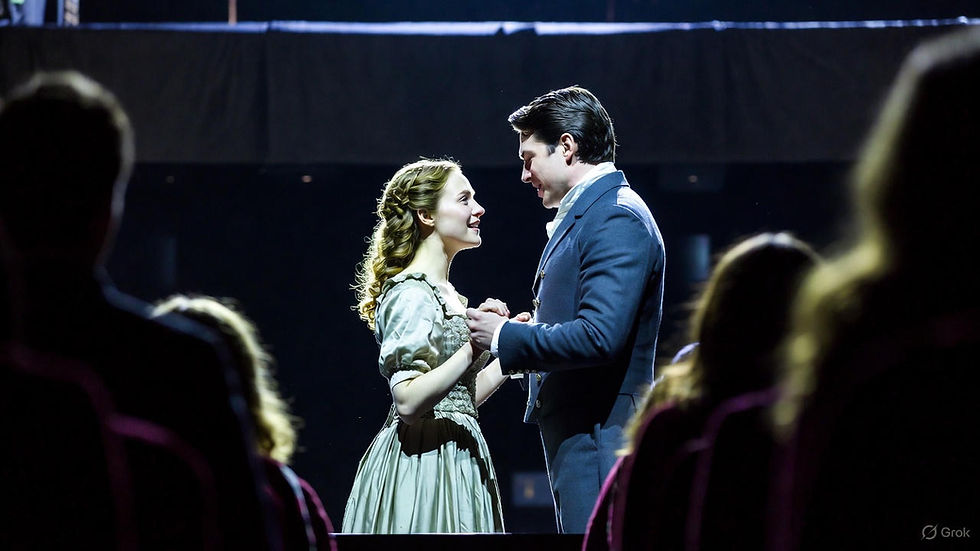
Live theater introduces time and motion, but it is still limited by physical space. Actors must project their performance to reach the back row. The audience remains aware of the stage, the distance, and the shared environment. Theater asks us to agree to the illusion—to accept that painted wood is a castle and a spotlight is the sun.
Cinema works differently. It does not ask for permission. It quietly takes control.
Cinema and the Control of Time
One of cinema’s most powerful tools is its control over time.
When watching a film, the viewer does not decide the pace. Time moves forward continuously, whether we want it to or not. We cannot pause a moment in the middle of a scene the way we can with a painting, nor can we choose to focus on a different corner of the frame. The film decides what we see and when we see it.
This matters because human perception is already tuned to experience life as a continuous flow. We do not normally experience reality as individual snapshots; we experience it as an ongoing stream. Cinema mirrors this structure. Once the brain accepts the flow of images, it stops questioning individual shots and instead follows the sequence as a single experience.
This is why editing works. A cut jumps across time and space in a way that would be impossible in real life, yet it feels natural. As long as the transition makes visual sense, the brain fills in the gaps automatically. We accept the jump without conscious effort.
In this way, movies don’t just show events—they guide the viewer through time.
Pareidolia: The Hunger for Faces

Movement and time are only part of the story. The emotional power of cinema largely comes from something much more basic: faces.
Humans are extremely sensitive to faces. We recognize them faster than almost any other object, and we are quick to read meaning into even the smallest expression. We often see faces where none exist—in clouds, electrical outlets, or random patterns. This tendency reflects how important faces are for social survival.
Cinema takes advantage of this sensitivity through the close-up.
On a theater screen, a human face can be many times larger than it would ever appear in real life. This scale forces attention. The viewer cannot look away or ignore subtle details. A slight change in the eyes, a tightening of the mouth, or a moment of hesitation becomes meaningful.
Unlike theater, where performance must be exaggerated to reach the audience, film allows emotion to exist at a much smaller, quieter level. The camera brings us closer than we are ever allowed to be in everyday life. This intimacy makes emotional reactions feel direct and personal.
Why Do We Feel what Characters Feel?
When we watch someone experience emotion on screen, we often feel a version of that emotion ourselves. This response doesn’t require us to believe the story is real. Even when we know a character is fictional, the visual information still triggers emotional understanding.
Seeing a human face in distress, joy, or fear activates the same perceptual systems we use when interacting with real people. The brain processes these expressions as social information first and fiction second. As a result, emotional reactions can feel automatic.
This is why films can move us deeply even when we fully understand that what we are watching is staged. The response comes from perception, not logic.
The Empathy Effect
Film critic Roger Ebert once described movies as “machines that generate empathy.” While poetic, the idea holds up in a practical sense.
Cinema combines controlled time, directed attention, and intense focus on human faces into a single experience. Together, these elements create a powerful emotional connection between viewer and image. We don’t just observe characters—we follow them, stay with them, and share their emotional space.
We love movies not only because they tell stories, but because they allow us to practice being human. They let us observe, feel, and connect in a focused, immersive way—safely, from the dark.
Cinema works because it aligns with how we already see the world. It doesn’t fight human perception. It works with it.

Comments